
Artificial intelligence is redefining how collaboration, creativity, communication, and critical thinking operate as foundational components of 21st Century Education. This approach to teaching shifts emphasis away from rote memorization towards the development of skills needed to construct arguments, evaluate information, and solve complex problems in a changing world. As artificial intelligence makes information and content easier to generate, the value of education will increasingly depend on how well students can question, discuss, refine, and apply information. For school districts, preparing for this shift does not mean designing technology-driven facilities around tools that may quickly become obsolete. It means investing in adaptable environments that strengthen the distinctly human abilities represented by the Four C’s of Education. Through WJA’s work with Florida school districts, programming conversations are increasing focus on how a single environment can support direct instruction, independent research, group problem-solving, digital exploration, and presentation throughout the school day. This creates an interconnected learning ecosystem in which learning commons, innovation hubs, critique spaces, and flexible classrooms support multiple tasks rather than a single prescribed activity.
Learning Commons as a Hub for AI-Assisted Collaboration
As schools explore AI-supported instruction, collaboration is expanding beyond traditional group work. Students can use AI to analyze information, generate ideas, and consider multiple perspectives. The educational value of collaboration, however, does not come from simply producing more information. It comes from working collectively to evaluate that information, reconcile different viewpoints, divide responsibilities, and develop a shared solution.
As these practices become more prevalent, traditional libraries and media centers must be reimagined as learning commons. While often used interchangeably, WJA defines learning commons as technology-rich environments that transform media centers into collaborative hubs supporting interdisciplinary, project-based learning. These environments accommodate movement among individual research, small group discussion, team problem-solving, and whole-group presentation without requiring students to leave the space.
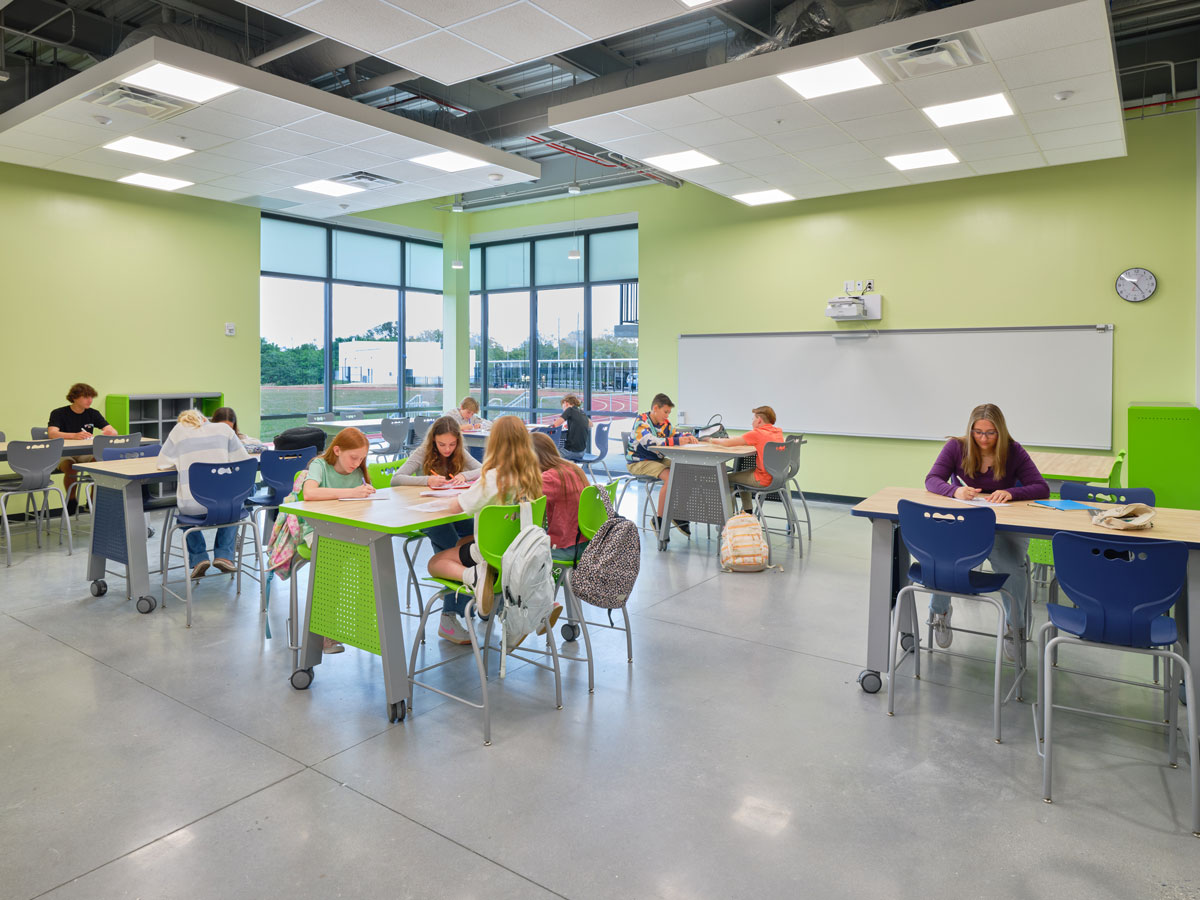
To support this evolution, architecture and interior design must provide flexible learning environments capable of accommodating multiple collaboration modes within a single space. Mobile operable walls constructed from writable panels or tempered glass create adaptable breakout zones while preserving sightlines and providing interactive surfaces for brainstorming, organizing ideas, and evaluating AI-generated responses. Movable furniture, accessible power, integrated displays, and varied seating configurations allow groups to reorganize as their work progresses.
These strategies allow independent research, group discussion, and project work to occur simultaneously while making collaborative thinking visible through shared physical workspaces. By enabling students to categorize evidence, challenge assumptions, compare approaches, and build consensus, learning commons position artificial intelligence as a resource within the collaborative process rather than a replacement for the human interactions foundational to learning.

Discussion-Rich Environments for AI-Assisted Communication
The presence of artificial intelligence in educational settings is transforming how students communicate inside and outside the classroom. As AI assumes a greater role in generating and compiling information, the emphasis of communication can shift from simply producing content to evaluating, explaining, and defending ideas. The value of communication increasingly lies in students’ ability to articulate their reasoning, challenge assumptions, support conclusions with evidence, listen to opposing perspectives, and adapt their ideas in response to feedback.
These changing instructional practices require educational facilities to support discussion-based learning. Small-group seminar rooms, presentation areas, flexible classroom configurations, and peer-review zones provide settings in which students can test ideas through conversation. Writable surfaces allow students to document how an argument develops, while integrated displays make it possible to compare sources, examine AI-generated responses, and present conclusions to different audiences.
Acoustical planning is essential to making these environments effective. Breakout spaces equipped with acoustical walls and ceiling panels minimize noise transfer while preserving speech intelligibility between groups. When paired with writable operable partitions, these elements create versatile environments that function as flexible room dividers and interactive work surfaces. This flexibility becomes particularly valuable as districts consolidate elementary and middle schools onto shared campuses, requiring common learning environments to accommodate different grade levels, group sizes, and communication styles throughout the day.
As AI changes how information is produced, edu
cational spaces must reinforce human exchange through which ideas are questioned, clarified, and understood. Discussion-rich environments help students develop confidence and judgment to communicate not only what they know, but also how they reached their conclusions.

Innovation Hubs for AI-Assisted Creativity
Of the four competencies most affected by artificial intelligence, creativity may experience the greatest transformation. AI-driven tools allow students to quickly produce multiple iterations, explore concepts, and develop preliminary models before physical creation begins. As a result, creativity is shifting from the initial generation of ideas toward the evaluation, refinement, and application of those ideas to solve complex problems. The educational value of creativity increasingly depends on students’ ability to analyze alternatives, make informed decisions, and transform concepts into meaningful solutions.
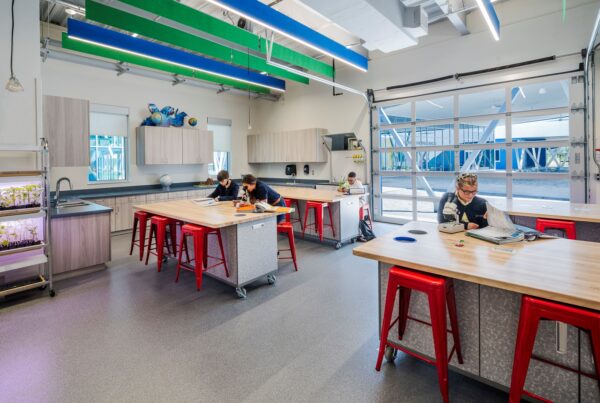
This transition requires educational spaces that support experimentation, collaboration, and visible thinking throughout the creative process. Traditional makerspaces, historically used to convert ideas into physical prototypes, must evolve into innovation hubs that support creative workflows spanning ideation, digital modeling, fabrication, and presentation.
Unlike traditional makerspaces focused primarily on physical production, innovation hubs integrate digital concept development, collaborative design, and prototyping within a single adaptable space. Interactive flat-panel displays, digital modeling tools, CNC fabrication equipment, and flexible worktables allow students to research, visualize, refine, and produce solutions seamlessly. Dedicated areas for messy fabrication, focused digital work, team discussion, and presentation allow different stages of the creative process to occur safely and simultaneously.
The goal is not to allow AI to make creative decisions for students. It is to give students the tools and environments to explore more possibilities while requiring them to determine which ideas are useful, responsible, and worth developing. By connecting digital exploration with physical testing, innovation hubs reinforce creativity as an iterative process of judgement, experimentation, and improvement.


Visible Thinking Environments for AI-Assisted Critical Evaluation
As artificial intelligence becomes increasingly integrated into education, critical thinking will become less about retrieving information and more about evaluating its accuracy, relevance, bias, and appropriate application. Because AI can produce convincing responses without guaranteeing that the information is complete or correct, students must learn to verify sources, compare perspectives, identify unsupported claims, and explain why particular evidence should be trusted.
Educational environments can reinforce this process by making thinking visible. Tackable walls, magnetic surfaces, writable partitions, and digital displays allow students to present research findings, compare AI-generated alternatives, map sources, and document how an argument changes over time. Instead of displaying only a finished product, these surfaces expose the decisions, questions, evidence, and revisions that led to it.
Flexible seminar configurations and critique areas further support peer review, teacher-guided evaluation, and evidence-based discussions. Side-by-side digital displays can help students compare sources or evaluate multiple outputs, while technology-free zones provide opportunities for independent reasoning, reflection, and face-to-face discussion. Together, these environments support different approaches to learning while reinforcing that technology is only one part of the thinking process.
AI-assisted learning also introduces questions related to accuracy, embedded bias, privacy, equitable access, academic integrity, and overreliance on technology. School design cannot resolve these issues independently, but it can support the instructional practices needed to address them. The goal is not to minimize the presence of AI. It is to create environments in which students learn when, why, and how to use it responsibly under the guidance of educators.

Strategic School Renovations for an AI-Assisted Future
Preparing schools for an AI-assisted future does not require districts to predict which technologies will dominate education. It requires them to invest in adaptable environments that support discussion, experimentation, evaluation, and the visible exchange of ideas. Learning commons, innovation hubs, critique spaces, and flexible classrooms can evolve alongside instructional practices while strengthening collaboration, communication, creativity, and critical thinking.
By prioritizing flexible infrastructure, varied learning settings, integrated technology, acoustical performance, and opportunities for both digital and technology-free work, school districts can make strategic capital investments that remain valuable as individual tools change. The most effective educational facilities will not be defined by the amount of technology they contain, but by how effectively they cultivate the human judgement required to use that technology responsibly.