
Resilience as Asset Management
The true cost of a resilient public safety facility design extends well beyond its initial construction. Decisions involving materials, building systems, site planning, and equipment placement influence how much a facility will cost to maintain, repair, and operate throughout its service life. They also determine how reliably it will perform during Florida’s most demanding conditions.
These considerations are particularly important for public safety facilities. Police stations, fire and rescue stations, emergency operations centers, and fleet facilities must remain operational during the same severe weather events that place the greatest stress on buildings and infrastructure. A maintenance issue that creates an inconvenience in another building can interrupt critical services in a facility that operates continuously.
For public safety facilities, resilience is not an added feature or a response limited to major storms. It is a long-term asset management strategy that protects operations, reduces avoidable maintenance, and helps public agencies make more effective use of limited capital resources. As public agencies balance capital needs, operating costs, and uncertainty surrounding Florida’s proposed 2026 property tax funding changes, facilities must be designed to be reliable and manage long-term maintenance demands.
Climate-responsive design anticipates how intense sunlight, heat, humidity, wind-driven rain, flooding, and severe storms will affect a facility over time. By limiting exposure, managing water, and protecting essential systems, public agencies can reduce premature deterioration, avoid preventable repairs, and extend the useful life of their investments.
Building Envelope Protection
Building envelopes in Florida are continuously exposed to extreme heat, ultraviolet radiation, moisture, and wind-driven rain. Over time, these environmental conditions can gradually deteriorate sealants, finishes, openings, and wall assemblies. If left unaddressed, this deterioration can lead to water intrusion, reduced insulation performance, mold growth, corrosion of structural components, and premature failure of building envelope systems.
Beyond increasing maintenance costs, these failures can disrupt the essential functions of public safety facilities. For example, mold growth resulting from water intrusion in a fire station’s decontamination room can compromise a designated clean zone and expose firefighters to airborne contaminants and respiratory irritants. This is particularly concerning because firefighters may have heightened respiratory vulnerabilities associated with smoke exposure.
To mitigate these conditions, deep roof overhangs can serve as a primary line of defense against Florida’s intense sun and wind-driven rain. While commonly used to reduce solar heat gain, overhangs also protect vulnerable building components from prolonged exposure to ultraviolet radiation and moisture. Working in tandem with effective flashing, appropriate drainage systems, and carefully designed roof and wall assemblies, they help limit water intrusion and weather-related deterioration. Overhangs do not replace proper waterproofing details, they reduce the environmental exposure placed on building components, helping extend service life and lower long-term maintenance demands.
The best maintenance strategy is often the one that prevents deterioration from occurring in the first place. Combined with high-performance, low-maintenance materials, deep roof overhangs help create resilient and cost-effective public facilities that experience less weather-related deterioration over time.

Resilient Site Design
Climate-responsive design extends beyond the four walls of a public facility. Landscape planning, grading, drainage, and irrigation all influence how effectively a site manages Florida’s cycles of intense heat, heavy rainfall, and periodic drought.
Landscapes that require significant irrigation, frequent replacement, or intensive care can increase operating costs. As funding becomes less predictable, landscape maintenance is deferred, declining vegetation health, soil erosion, and obstructed drainage pathways can contribute to uncontrolled stormwater runoff. Over time, these conditions may affect foundations, slabs on grade, utilities, and other building components.
Florida-Friendly landscaping principles offer a more resilient approach by prioritizing vegetation suited to the site’s soil, sunlight, moisture, and climate conditions. Appropriate plant selection can reduce irrigation and maintenance requirements while supporting long-term landscape health.
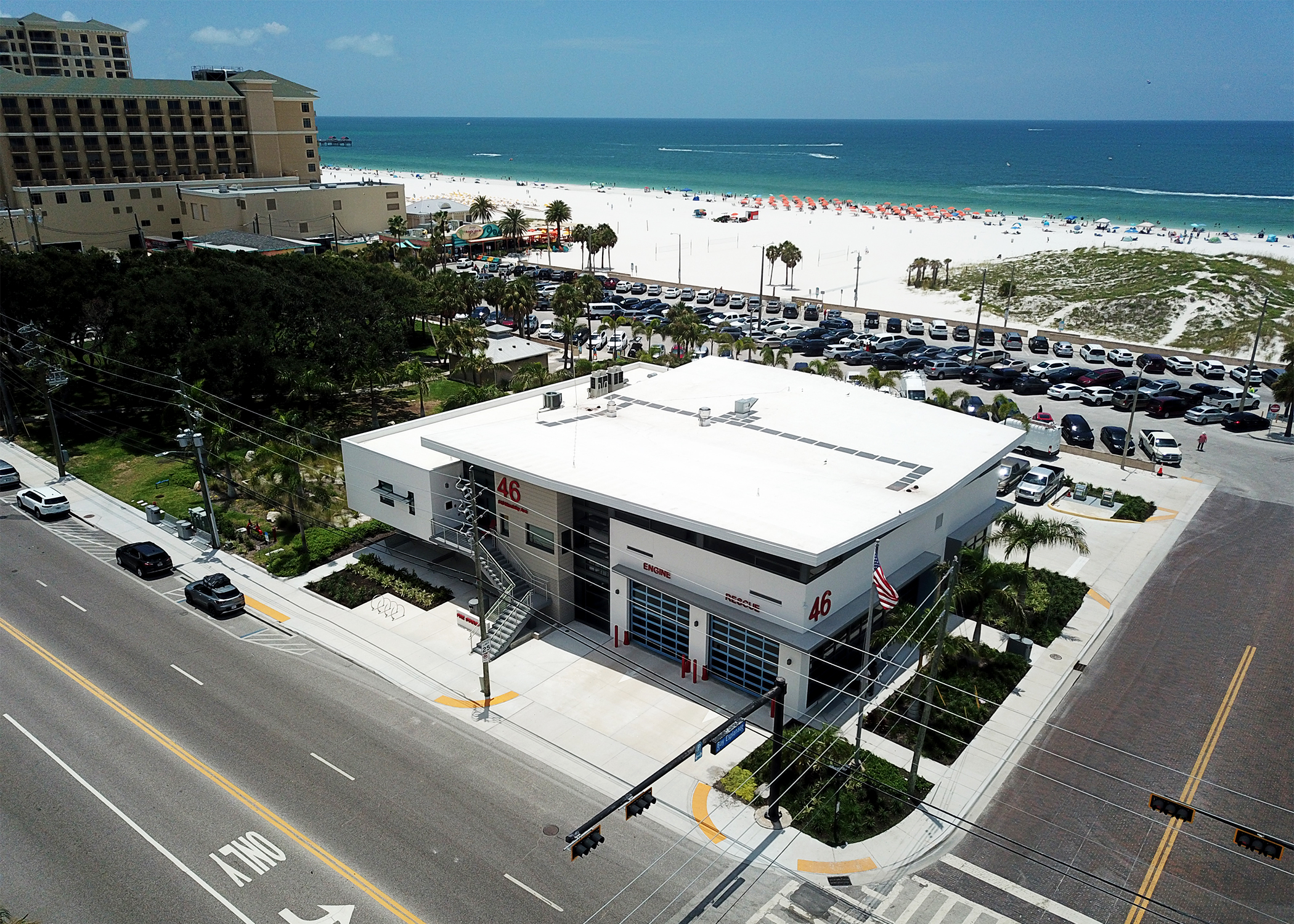
When strategically selected and located, vegetation can also stabilize soil, support water absorption, and slow stormwater movement seen in Fire Station 46 on Clearwater Beach. Combined with proper grading, bioswales, rain gardens, and retention systems, resilient landscaping helps direct water away from buildings and manage it before it reaches foundations, utilities, and other vulnerable components.
When architecture, civil engineering, and landscape design are coordinated at the beginning of the design process, the site becomes an active system for managing water, reducing environmental stress, and protecting the facility over time.

Protecting Critical Systems
The goal of resilient landscape planning is not only to reduce irrigation and maintenance, but also to treat the entire site as part of the facility’s protective infrastructure. Generators, transformers, fuel systems, electrical switchgears, communication infrastructure, and other essential equipment must remain accessible and operational during emergencies.
Locating critical equipment and systems without fully accounting for flood risk, storm surge, debris, corrosion, and water intrusion can expose municipalities to equipment failure, operational interruptions, and significant repair and replacement costs. These risks are particularly consequential when a facility must support emergency response during and immediately after a storm.
Elevating essential equipment is one of the most effective ways to reduce the risk of catastrophic damage. Depending on the facility and site, equipment may be located on upper floors, structural platforms, curbs, or engineered support systems designed in accordance with applicable flood-resistant requirements. Raising these components above anticipated flood conditions reduces their susceptibility to inundation from floodwaters and storm surge.
This strategy can directly support continuity of operations during coastal storm events. Fire Station 46 on Clearwater Beach, designed by WJArchitects, demonstrates this approach. During Hurricanes Helene and Milton, the station maintained power because its emergency generator was located approximately 15 feet above sea level in a protective enclosure. Once floodwaters receded, the facility resumed operations and became an important community recovery point, with residents visiting the station to receive food and water in the apparatus bay.
The outcome was no accidental. It demonstrates how decisions made during design can protect essential operations years later, when a public facility and the services it provides are needed most.
Equipment resilience also requires planning for maintenance and eventual replacement. Adequate access, service clearances, and flexible support systems allow agencies to modernize equipment as technologies and operational requirements change. Because replacement equipment may differ in size and configuration from the original installation, this flexibility can simplify future work and reduce the likelihood that modernization will require extensive building modifications.


Design as an Asset Management Strategy
Climate-responsive design is more than a sustainability strategy; It is a form of long-term asset management. By anticipating environmental stress, coordinating building and site systems, and protecting critical equipment, public agencies can reduce preventable deterioration, improve operational continuity, and gain greater predictability over life cycle costs. For public safety facilities expected to serve communities under the most demanding conditions, these outcomes are fundamental to responsible design.